Article
The "Better Infra" Myth: Why AI is Hitting a Giant Wall (and How We’re Jumping Over It)
March 17, 2026
4 min read
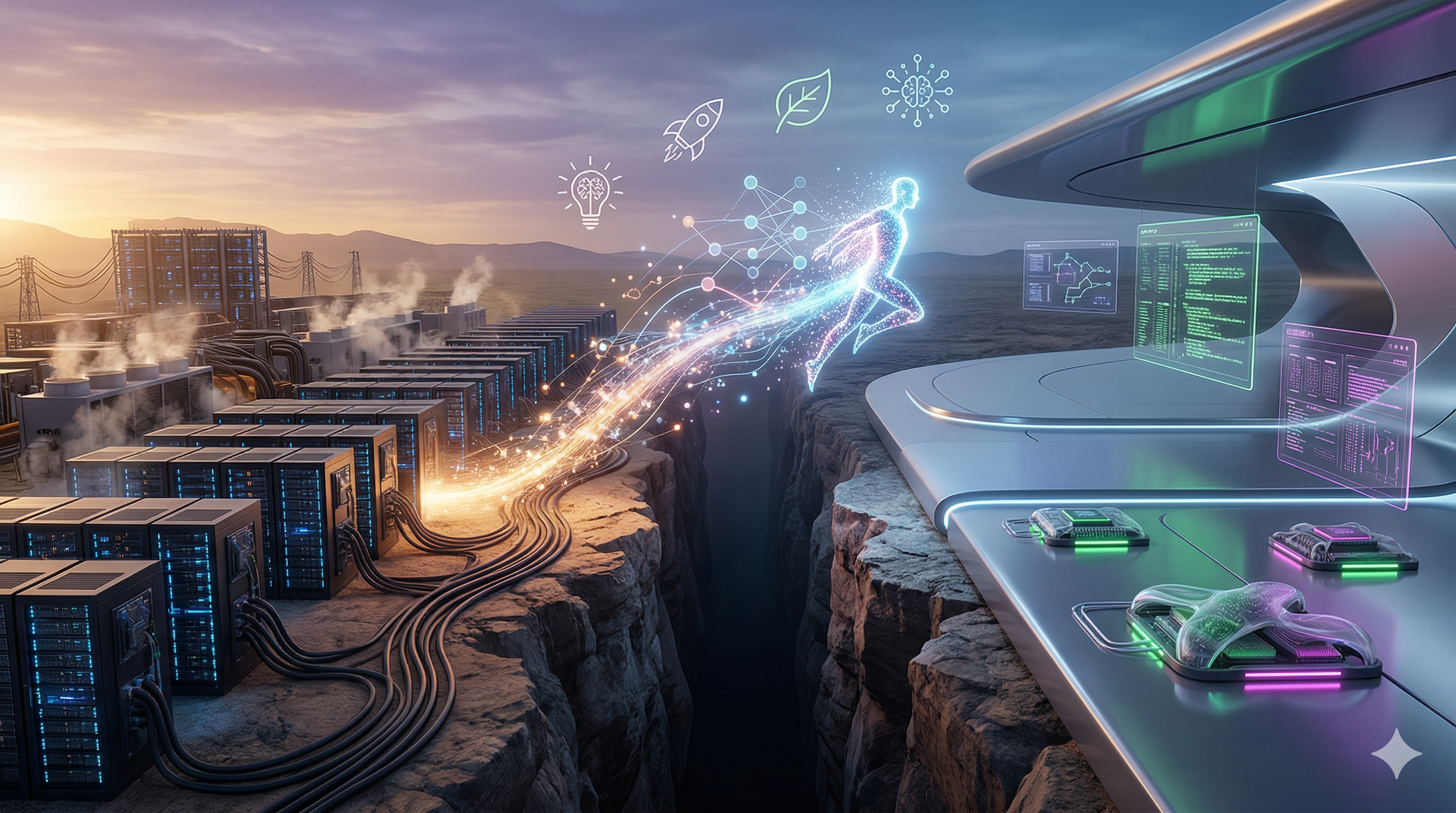
We’ve all heard the hype: "If we just build bigger data centers and buy more GPUs, AI will become god-like." It sounds logical, right? Better tools = better results.
But here’s the spicy truth for 2026: The equation "Better Infra = More Powerful Models" is officially broken.
In fact, we’ve hit what experts call a "Great Filter" for AI. If we kept just throwing hardware at the problem, we’d run out of electricity before we reached true AGI. Let’s dive into why the "brute force" era is ending and how the Moore’s Law Paradox is forcing AI to finally grow up.
________________________________________
1. The 1/20th Rule: The Law of Diminishing Returns
Imagine you’re baking a cake. Adding a second oven helps you bake two cakes. But by the time you have 100 ovens, you’re spending all your time just walking between them, and the kitchen is so hot the frosting is melting!
That’s AI right now. To make a model just 5% smarter in its reasoning, we’re having to increase the infrastructure by nearly 100x. We are spending billions for tiny, incremental gains. This "Scaling Law Paradox" means that simply being "bigger" isn't making models "better" anymore- it’s just making them more expensive and slower.
________________________________________
2. The Moore’s Law Wall (It’s getting crowded in here!)
For decades, Moore’s Law (doubling transistors every 2 years) was the wind beneath our wings. But we’ve reached the 1.8nm and 2nm nodes, and physics is literally saying "No more."
At this tiny scale, electrons start "leaking" (quantum tunnelling), creating massive heat. We can't just shrink chips further. So, "Better Infra" now means building data centres the size of small cities. In 2026, the question isn't "How many GPUs do you have?" but "Can your local power grid stay online while you run a prompt?"
________________________________________
3. The Great Shift: From Brute Force to Elegance
So, how are we surviving this "Valley of Death"? By getting elegant. If you look at the journey from 2023 to where we are now in 2026, the strategy has flipped completely.
Back in 2023, we were in the "Brute Force Era." We thought bigger was always better, pushing models to nearly 2 trillion parameters. It was like building a massive, heavy engine that gulped down electricity just to move an inch. Today, our most powerful frontier models are actually much smaller (around 500 billion parameters) but they are highly optimized and far more capable.
The real magic, though, is in the "cost of thinking." Three years ago, it took a significant amount of energy just to generate a single sentence. Now, thanks to better architecture, that cost has plummeted. We've managed to make AI 15 times cheaper and more efficient to use in our daily lives.
This is the "New Moore’s Law" in action. We aren't just doubling the number of chips anymore; we are doubling the intelligence we get out of every watt of power. We’ve stopped trying to build a bigger hammer and started building a sharper, smarter needle.
________________________________________
4. The New "AI Moore’s Law"
The new goal isn't "More Transistors." It’s "Intelligence per Watt."
The winners of the AI wars in 2026 aren't the ones with the most money for electricity. They are the ones using:
• SLMs (Small Language Models): High-quality data over high-quantity chips.
• Optical Computing: Using light instead of electricity to stop the "heat wall."
• On-Device AI: Processing on your phone instead of a massive cloud.
________________________________________
The Bottom Line
Infrastructure is a foundation, not a fuel. If we rely only on "more infra," AI becomes a laboratory curiosity that's too expensive for anyone to actually use. To jump the valley, AI has to become aerodynamic: - lean, efficient, and thoughtful.
The "Brute Force" era was fun, but the "Elegance" era is where the real magic happens.
What do you think? Is the "GPU War" still the only thing that matters, or is it time to start valuing efficiency over raw power?
Reading Notes
Continue exploring
More essays, reflections, and product notes from the archive.
View All BlogsMore from the archive
Related Posts

March 15, 2026
Google's Stitch may kill Canva and Figma, sooner than you think!
Remember the dark ages? The days when designing anything, from a simple social media graphic to a complex user...

February 15, 2026
🚀 I improved my AI‑assisted coding productivity by 48×–70×
Two phases. Same person. Same effort. Completely different outcomes. 𝗣𝗢𝗖 (𝟲 𝘄𝗲𝗲𝗸𝘀) - 2.8 KLOC - 26 fi...
June 14, 2025
Have you ever tracked a loved one’s cab ride in real time, refreshing the screen every few minutes, heart racing every time the car takes a turn you didn’t expect? I’ve been there too — too many times.
It’s a familiar routine: • Click on the live location link • Zoom in • Refresh • Panic when the car turns slig...